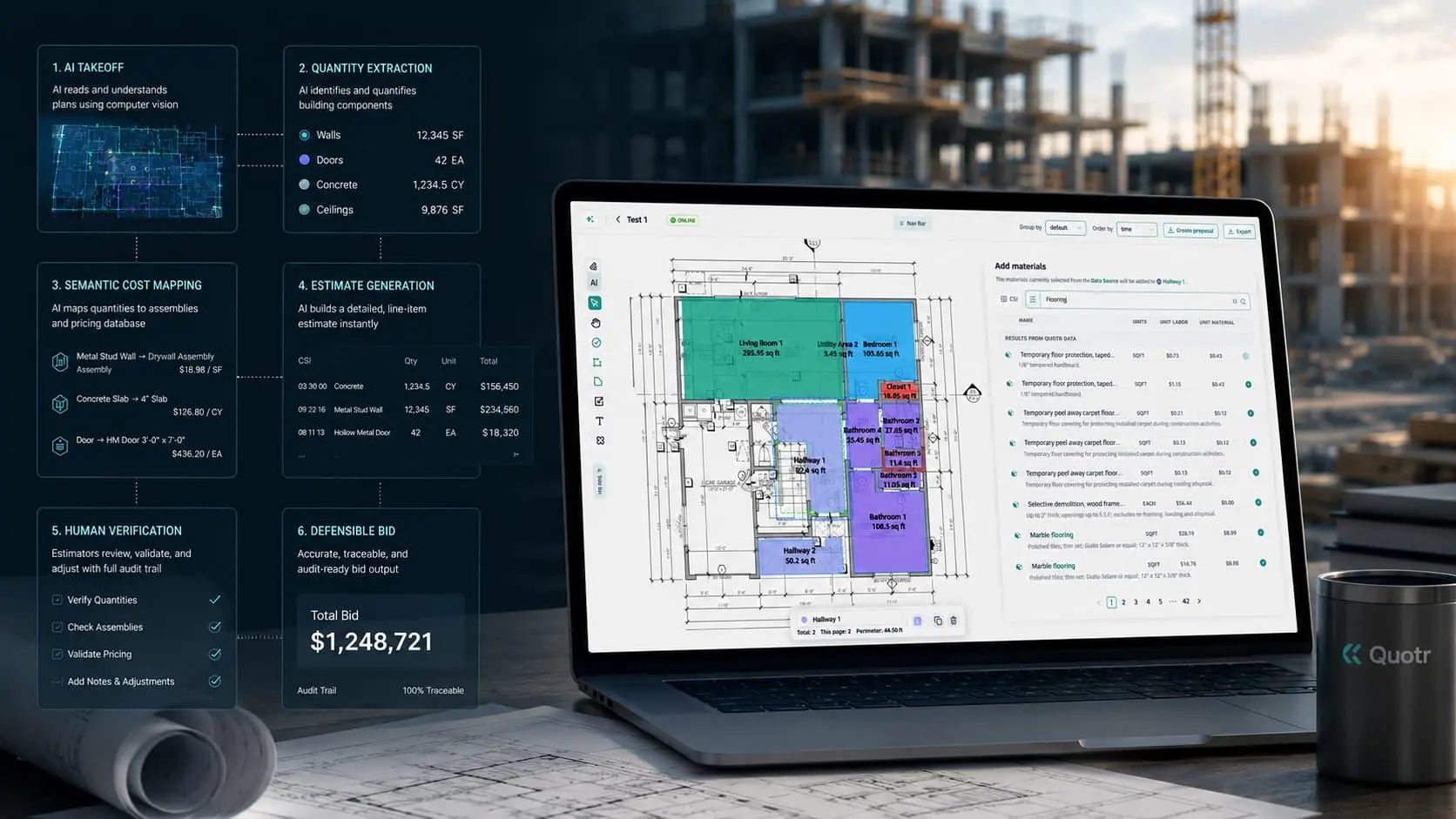
The manufacturing and MEP contracting business has consistently been run on razor-thin timelines and razor-thin margins. Every bidding cycle requires accuracy, speed, and confidence; however, for many years, quantity takeoffs have been one of the most time-consuming and error-prone steps of all prefabrication methodologies. Today, that truth changes quickly. Artificial intelligence (AI) is no longer a futuristic buzzword reserved for tech companies; It has become a discreet, sales-driven tool for contractors, estimators, and project owners who need to bid faster, pay more accurately, and earn a more profitable picture. Full AI-based amount valuation strategies are transforming how companies methodically fly with automation, accuracy transforming information manual calculations, what AI amounts to through the offering lifecycle, what measurable business value it can deliver, and how forward-thinking companies are using it to leverage sustainable aggressive share in a growing number of aggressive markets.
2. Shift from manual calculations to intelligent analytics
For years, the estimation branch has been the bottleneck of the tender system. Estimators spent days, sometimes weeks, manually scaling drawings, calculating furniture, and cross-referencing specifications, and even as everything raced to a submission date, this manual method isn’t always just slow; it is inherently inconsistent, in that accuracy depends heavily on the person rater revel in and fatigue levels. Takeoff tools based primarily on AI solve this by using pattern recognition and prediction to examine virtual images, usually find symbols, produce quantities in a piece of time, and improve accuracy. This is mainly transformative in specialized trades such as electrical estimating, circuit layout, drilling, circuit drilling, and automation. Pattern recognition and quantity extraction: AI enables guessing teams to redirect their knowledge toward pricing processes, contingency analysis, and customer relations areas where human judgment really adds fees instead of repetitive calculation duties
Deliveries
- Manual flying is sequential, inconsistent, and heavily dependent on individual predictive capabilities.
- AI-powered tools use computational intelligence and predictive analytics to detect vehicle signs and produce parts faster.
- Automation frees skilled appraisers for awareness of pricing processes and remediation controls.
- Specialized companies with intensive graphics disproportionately benefit from automation.
3. Traditional versus AI-based spaceflight: a side-by-side comparison
The numbers tell the story more convincingly than the critics. The office below compares traditional manual startup methods against AI-based full-quantitative assessment across the metrics that matter most to a bidding commercial company: speed, accuracy, fees, and scalability.
| Metric | Traditional Manual Takeoff | AI-Based Quantity Analysis |
| Average Time per Project | 15–25 hours | 3–6 hours |
| Typical Accuracy Range | 85%–92% | 96%–99% |
| Staffing Requirement | 2–4 estimators per bid | 1 estimator + AI validation |
| Rework/Error Correction Rate | 10%–15% of bids | 2%–4% of bids |
| Scalability for Bid Volume | Limited by headcount | Scales with software capacity |
| Cost per Estimate (avg.) | $600–$1,200 | $150–$400 |
To visualize the turnaround time effect over a typical bidding cycle, take the simplified method below, which depicts the hours spent according to the company for increasing use of AI
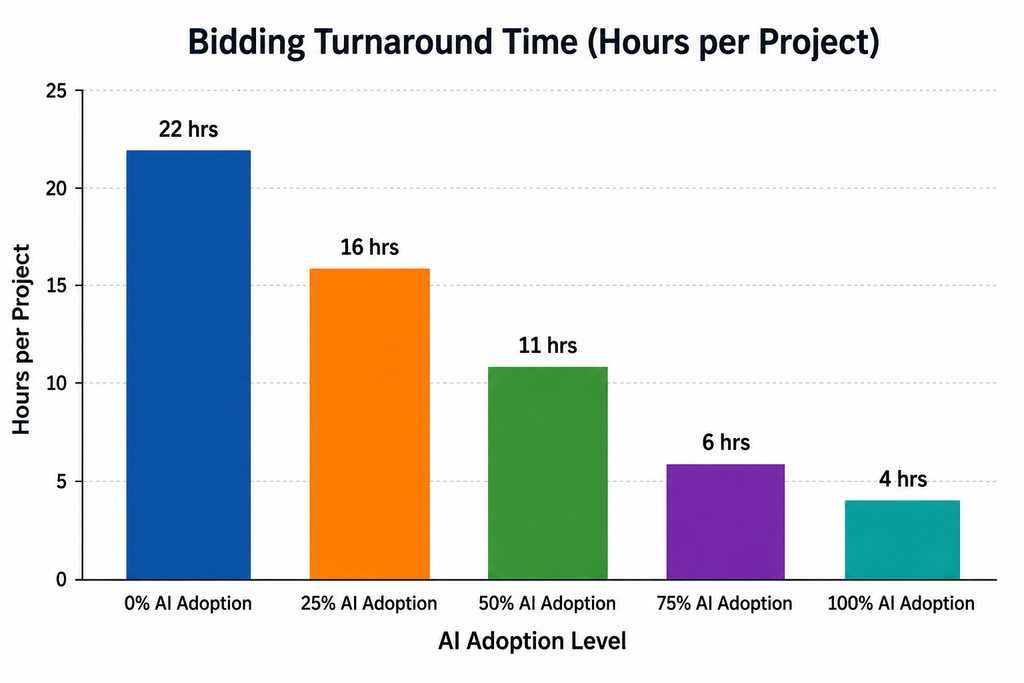
The trend line makes the business case clear: As the use of AI increases, turnaround times decrease dramatically, allowing companies to issue more offers without increasing headcount — immediately increasing win-pay opportunities and top-line growth.
4. Faster messages without sacrificing accuracy
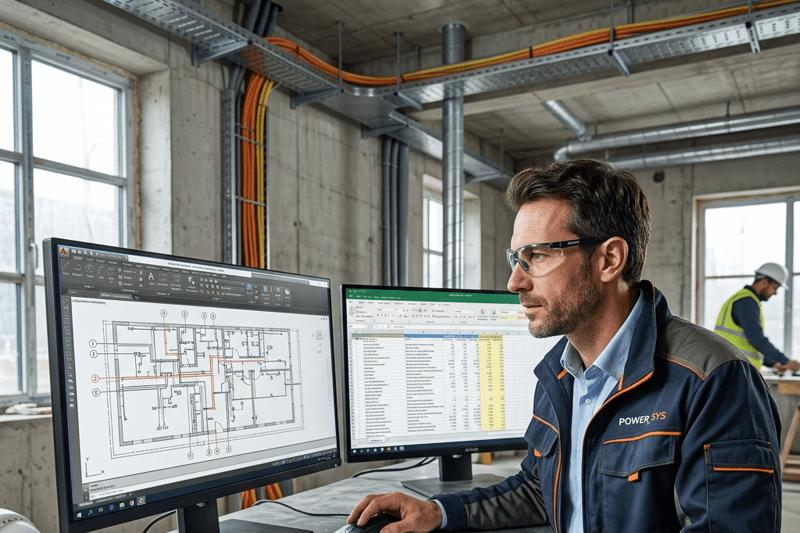
Speed and accuracy are traditionally seen as opposing forces in assessment; the faster you go, the more likely you are to overlook something. Amount valuation based on A violates this agreement. Fashion designers trained on thousands of drawing sets find ways to recognize the machine and understand icons, styles, and formatting conventions with a consistency that guides judgments in reality that size cannot match. This is especially valuable for companies providing electrical estimating services, where accuracy in calculating equipment, breaker runs, and cable runs directly determines whether an offer is profitable or a legal liability. AI, by validating results, tracking pricing specifications, and well-advanced closure of Fashelight dates, not only reduces pressure during periods of crisis it allows a company to simultaneously pursue multiple opportunities, effectively increasing overall addressable pipeline without a proportional increase in labor.
Deliveries
- AI eliminates the traditional trade-offs between speed and accuracy in assessment.
- Machine learning models distinguish styles and logos at scale with even greater consistency.
- Faster supply changes expand management capacity without introducing headcount.
- Appraisers are moving from record mining to value-fetched verification and pricing.
5. Margin Impact
Beyond momentum lies the real business case for A-based sum analysis in margin protection. Estimating errors,s whether from excess quantities or miscalculated terms or not, is one of the leading causes of margin erosion in fixed-rate contracts. The whitepaper below breaks down the predicted margin impact of AI adoption across different engagement sizes, based primarily on the traditional business model.
| Project Size | Avg. Margin Loss from Estimating Errors (Manual) | Avg. Margin Loss from Estimating Errors (AI-Assisted) | Estimated Margin Improvement |
| Small ($100K–$500K) | 3.5% | 1.0% | +2.5% |
| Mid-Size ($500K–$2M) | 4.2% | 1.3% | +2.9% |
| Large ($2M–$10M) | 5.0% | 1.5% | +3.5% |
| Enterprise ($10M+) | 6.1% | 1.8% | +4.3% |
The pattern is clear: the larger and more complex the challenge, the greater the economic proposition of AI-assisted accuracy. A three- to four percent factor margin development in a multibillion-dollar deal can create hundreds of greenbacks in residual profits — capital that can be reinvested in equipment, personnel, or business development as opposed to being absorbed as losses.
6. Boosting growth through strategic technology partnerships
Adopting quantitative analytics, which is primarily based on AI, is not just a choice of software; it is a business process. Businesses that integrate AI into their pre-construction workflow are working themselves into tackling better bid volumes, pursuing larger and more complex campaigns, and responding to RFPs at a pace that trades’ competition can’t really match. Many mechanical-estimating services are choosing to enhance this capability by partnering with specialized manufacturing and evaluation companies that combine AI-powered flight software with skilled human oversight, ensuring speed and reference accuracy. This hybrid approach time plus professional certification— has become the standard for highly specialized companies. As the volume of offers increases, so does the opportunity to be selective about which projects to pursue, so that companies prioritize work with high returns rather than accepting all opportunities to live really busy.
Deliveries
- Adoption of AI is a growth driver, not just a productivity machine.
- By combining an AI software program with human perception, hybrid fashions provide high-quality accuracy.
- Higher bidding allows firms to be more selective of proposed profitable projects.
- Strategic technology partnerships accelerate scaling with proportional cost increases.
7. Final Thoughts
AI-primarily based sum pricing is not an experimental advantage reserved for large companies. Baseline expectations in the bidding landscape turn around quickly. Companies that rely entirely on manual-flight strategies risk losing bids not because their pricing is incorrect, but because of few connections. Winning the most profitable images today are agencies that combine automated volume extraction with efficient evaluation decisions, using time to remove repetitive images despite the human perception that pricing methods honestly call for. The result is a faster bid cycle, tighter margins covered by avoidable errors, and a scalable foundation for long-term project success. As AI tools mature, the gap between early adopters and guided best-in-class competitors is narrowing; now is the right time to evaluate how these strategies fit into your personal inference workflow.
Frequently Asked Questions
Q1: How much faster is a fully AI-based spaceflight compared to manual techniques?
A: In general, AI-mainly based flights reduce estimation time by 60%–80%, depending on task complexity, reducing the typical 15–25-hour manual type to 3–6 hours.
Q 2: Does AI completely update human forecasts?
A: No, AI automates iterative volume mining, but human raters are still important for pricing processes, risk assessments, and validation of results for challenge-specific context.
Q3: Are AI-based predictions perfectly adequate for aggressive bidding?
A: Yes. AI-based summation analysis typically achieves 96%–99% accuracy, compared to 85%–92% for manual flights, significantly reducing redundant redirections and trade order disputes
Q 4: What types of campaigns benefit most from A-based summation analysis?
A: Larger and more complex campaigns see the most marginal improvement, given that even small percentage errors translate into huge dollar amounts in better-value contracts.
Q5: How can an organization start implementing A-based forecasting strategies?
A: Most companies start by taking AI takeoff applications for high-volume alternative applications, then scale it up incrementally, regularly supported by specialized speculation partners who integrate the technology with corporate intelligence.
Also Read
- DPWM Meaning in Texting: What Does DPWM Mean in Text?
- SN Meaning in Texting: What Does “SN” Mean in a Text?
- Financial Clarity Requires Emotional Honesty