
Balloon is an online crash game where players inflate a virtual balloon and try to cash out before it bursts. Unlike many crash games, it does not use a rising graph or flying object. Instead, players press and hold a button to inflate the balloon. The longer the button is held, the bigger the balloon gets and the higher the multiplier rises. If the balloon bursts before cash-out, the round ends with no payout. Balloon was developed by SmartSoft Gaming and uses a simple interface with short, fast rounds. The game is sometimes described as a balloon game money title because its multipliers determine the potential return from each stake. Still, a successful cash-out is never guaranteed. This guide explains how the Balloon game online works, including its rules, inflation mechanics, RTP, payout calculations, and differences from other crash games.
What Is the Balloon Game Online?
Balloon is an interactive crash-style game developed by SmartSoft Gaming. Instead of spinning reels or matching symbols, players control an inflating balloon. The aim is to release the inflation button before the balloon bursts. Each round begins with a selected stake. As the balloon grows, its multiplier increases. Releasing the button in time ends the round and calculates the payout. If the balloon bursts first, the player loses the stake for that round. The game has no traditional slot reels, paylines, or symbol combinations. Its central feature is the decision of when to stop inflating.
How the Balloon Crash Game Works
The gameplay is simple. The player chooses a stake, presses the inflation button, and watches the balloon grow. The multiplier rises while the button is held. For example, a ₹100 bet at 1.50x gives a total payout of ₹150 if the player releases the button in time. If the balloon bursts first, the payout is zero. The player controls when to release the button, but not when the balloon will burst. This makes the game feel partly skill-based, even though the final result is still uncertain.
Who Developed the Balloon Game?
Balloon was created by SmartSoft Gaming, a developer known for interactive casino games. The company also created JetX, a crash game launched in 2018. While JetX features a rising aircraft, Balloon uses an inflating balloon and a more direct control system. SmartSoft’s official description presents Balloon as a crash-style game in which multipliers rise until the balloon pops.
Balloon Game Rules and Main Features
The rules are straightforward, but understanding how inflation, cash-out, and bursting work is essential before starting a round.
| Game feature | Description |
| Developer | SmartSoft Gaming |
| Game category | Crash / instant game |
| Main control | Press and hold |
| Multiplier | Increases during inflation |
| Cash-out action | Release the button |
| Losing condition | Balloon bursts before release |
| Reported RTP | 96% |
| Gameplay format | Individual rounds |
Balloon Inflation and Multiplier Growth
Inflation is the main action in Balloon. After selecting a stake, the player presses and holds the main button. The balloon gradually expands as the multiplier rises. Unlike a standard crash graph, the balloon provides a visual representation of increasing risk. A larger balloon usually represents a higher displayed payout, but it does not reveal the exact burst point.
For instance, a player may reach 1.20x in one round and continue toward 2.00x. The balloon could burst before reaching that second target.
How the Cash-Out System Works
Cash-out happens when the player releases the inflation button before the balloon bursts. The payout depends on the stake and the multiplier shown at that moment. For example, a ₹200 bet collected at 1.80x returns ₹360. This includes the original ₹200 stake, so the net gain is ₹160. Unlike many crash games, Balloon does not use a separate cash-out button. The same button used to inflate the balloon is also used to end the round.
What Happens When the Balloon Bursts?
If the balloon bursts before you release it, the round ends at once. You get no payout and lose the amount used for that round. The balloon can burst at different points, and earlier rounds do not predict what will happen next. There is also no clear visual warning that guarantees enough time to release. A high multiplier in one round does not mean the next balloon will behave the same way.
How to Play Balloon Game Online Step by Step

Balloon has a short learning curve because most actions take place on one screen. The following steps explain the basic interface and the order of a typical round.
Step 1: Open the Balloon Game
Find Balloon by SmartSoft Gaming in a game catalogue or compatible demo interface. Check the game title and developer because other games also use balloon themes. Once loaded, the screen displays the balloon, stake controls, and the button used for inflation. The game usually has a blue background with a yellow balloon in the centre.
Step 2: Select the Stake Amount
Before starting, choose a stake from the available values. The amount determines how much is at risk and how the displayed multiplier translates into a payout. For example, a ₹50 stake collected at 2.00x produces ₹100, while a ₹100 stake at the same multiplier produces ₹200. A higher stake does not improve the chance of reaching a particular multiplier. It only changes the size of the potential gain or loss.
Step 3: Press and Hold the Inflation Button
Press the main button and keep it held down. The balloon starts expanding and the multiplier increases. One common mistake is tapping the button once, as players might do in other crash games. Balloon uses continuous pressure rather than a single tap to control inflation. The player must maintain the hold until choosing to release.
Step 4: Monitor the Growing Multiplier
As the balloon becomes larger, the displayed payout increases. Watch the multiplier or payout amount shown on screen. Suppose a ₹100 stake reaches 1.40x. The total payout at that point is ₹140. Continuing to hold the button may increase the potential payout, but it also leaves the stake exposed to a burst. There is no need to calculate every value manually during a round. The interface displays the changing amount.
Step 5: Release the Button to Cash Out
Release the button while the balloon is still intact. A successful release ends the round and collects the payout at the accepted multiplier. For example, releasing at 1.75x with a ₹100 stake produces ₹175. If the balloon bursts before the release is processed, the round is unsuccessful. There is no partial payout simply because the balloon reached a certain size earlier.
Step 6: Review the Round Result
After the round ends, check whether it produced a payout or a loss. If successful, compare the total payout against the original stake to find the net result. If the balloon burst, the net result is a loss equal to the stake. For example, a ₹100 stake collected at 1.60x returns ₹160 and produces a ₹60 gain. If the balloon bursts, the net result is -₹100. Each new round should be considered separately. A previous payout or burst does not establish what will happen next.
Understanding Balloon Game Multipliers and Payouts
The multiplier determines how much a successful round pays. It starts at a low value and grows while the balloon inflates. Players can release the button to collect the current amount or continue holding it and risk losing the stake. Higher multipliers offer larger potential payouts, but they do not guarantee better results. The balloon may burst before reaching the desired value.
How Multipliers Affect the Payout
Balloon uses a straightforward payout calculation:
Total payout = Stake × Cash-out multiplier
The net result is the total payout minus the original stake. For example, a ₹200 stake collected at 2.50x produces a total payout of ₹500. The net gain is ₹300. If the balloon bursts, the payout is zero, regardless of the multiplier it reached before bursting.
Does a Higher Multiplier Mean a Higher Risk?
Yes. In crash-style games, waiting for a higher multiplier usually means taking more risk. A 1.30x target needs the balloon to stay active for less time than a 5.00x target. The lower target is not guaranteed, but it is less risky. The main trade-off is simple: a higher possible payout comes with a greater chance of losing the full stake. No multiplier can guarantee profit. Even many small wins can be wiped out by later losses.
Balloon Game RTP and Random Outcomes

Return to Player, or RTP, is a standard measure used in casino games. It describes the theoretical percentage of total stakes that a game returns over a very large number of rounds. Balloon is commonly listed with an RTP of 96%, including on the supplied 1xBet game page. This figure does not tell players what will happen during a particular round.
What Does the 96% RTP Mean?
An RTP of 96% means the game is theoretically designed to return ₹96 for every ₹100 wagered over a sufficiently large number of plays, averaged across its mathematical model. It does not mean that someone who stakes ₹100 will receive ₹96 back. A single round might end with no payout or a payout much larger than the stake. The remaining 4% represents the theoretical house edge. RTP describes long-term mathematical expectations, not short-term results. For example, if ₹10,000 is wagered across many rounds, a 96% RTP corresponds to an expected return of ₹9,600 and an expected loss of ₹400. Actual results may differ considerably. The stated RTP may also depend on the game configuration offered by a particular operator, so the in-game information is the relevant reference.
Can Players Predict When the Balloon Will Burst?
There is no verified method for predicting the next burst from the visible balloon animation or previous payouts. The balloon’s size shows how far the current round has progressed. It does not provide a reliable signal that the next moment is safe. Some players look for patterns, such as several early bursts followed by an expected high multiplier. However, a sequence of results does not establish that another particular outcome is due.
Why Previous Rounds Do Not Guarantee Future Results
If outcomes are generated independently, previous rounds do not affect the mathematical chances of the next round. Imagine the balloon bursts before 1.50x in four consecutive rounds. That sequence does not guarantee that the fifth round will reach 3.00x or higher. The same applies after a large payout. A successful round does not mean that the next balloon will burst early. Understanding this helps separate the game’s visual excitement from its underlying uncertainty.
Balloon Game Demo Mode vs. Real Money Play
Balloon is also available in a demo format, often described as Fun Mode. SmartSoft provides a demo entry point on its official game page. The demo version allows users to explore the inflation controls, multiplier display, and cash-out process without committing real money.
How Balloon Demo Mode Works
In a demo session, the player uses virtual credits instead of real funds. The basic interaction follows the same pattern as the standard game: choose a virtual stake, hold the inflation button, and release it before the balloon bursts. Demo mode is useful for understanding how the interface responds to pressing and releasing. It also makes it easier to compare displayed payouts with calculated net results. However, practice does not provide information that can reliably predict later outcomes.
Differences Between Demo and Real Money Rounds
The most important difference is financial exposure. In demo mode, losing a round reduces a virtual balance. In real-money play, the same result can cause an actual financial loss. Demo gameplay also may not reproduce every technical or account-related condition of a live-money session. The available game configuration, limits, and interface details can vary. A successful demo session should not be treated as evidence that the same results will occur with real stakes.
Practical Tips for Understanding Balloon Gameplay
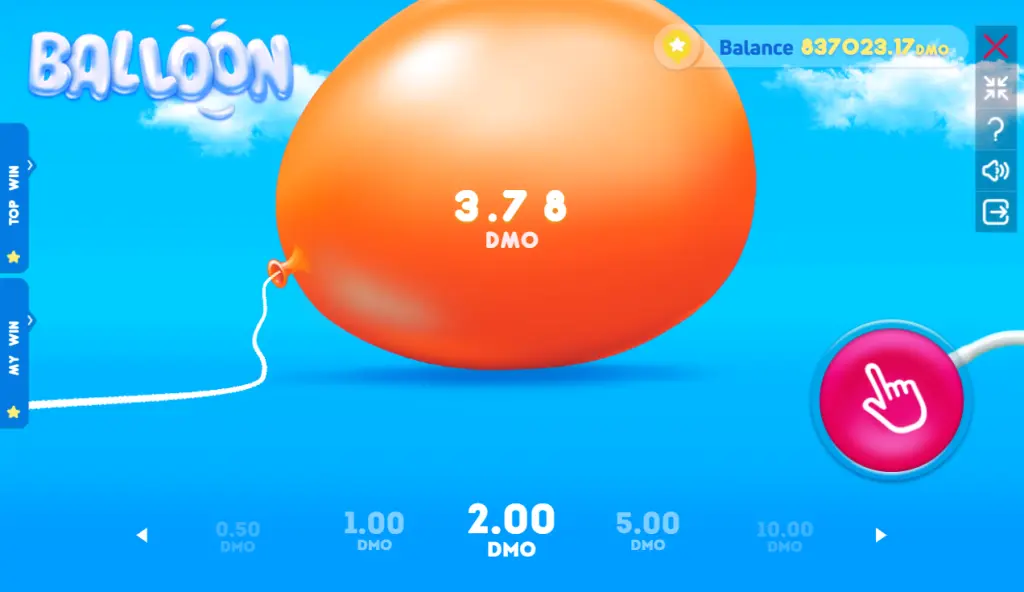
Balloon has simple controls, but players can still misunderstand the relationship between inflation, multipliers, and risk. The following points help explain the decisions involved without claiming that any approach can overcome the game’s house edge.
Set a Cash-Out Target Before Each Round
Choosing a target in advance can make the decision to release more consistent. For example, consider two hypothetical approaches. One player plans to release at 1.30x, while another aims for 3.00x. The first target offers a smaller total payout but requires the balloon to survive for a shorter period. The second offers a larger payout if reached, but exposes the stake to the risk of bursting for longer. Neither target produces a guaranteed advantage. A fixed target is primarily a way to manage decisions, not a method of changing the game’s underlying probabilities.
Understand the Difference Between Low and High Multipliers
A low multiplier does not necessarily mean low overall financial risk. The size of the stake and the frequency of rounds also matter. Suppose a player collects four successful payouts at 1.20x using a ₹100 stake each time. Those four rounds produce ₹80 in combined net gains. If the fifth round bursts with the same stake, the ₹100 loss leaves the player ₹20 behind overall. This example shows why repeated small payouts do not automatically create a profitable strategy. Likewise, aiming for high multipliers can produce occasional large payouts alongside long sequences of losing rounds.
Avoid Increasing Stakes After Losing Rounds
Increasing the stake after a burst does not make the next balloon more likely to survive. Consider a player who begins with ₹50 and doubles the stake after every unsuccessful round. After four consecutive losses, the stakes would have been ₹50, ₹100, ₹200, and ₹400. The total loss would reach ₹750. This pattern makes financial exposure grow quickly without changing the result probabilities. A predetermined spending limit and stopping point are more useful for controlling losses than trying to recover them through progressively larger stakes.
Balloon Game vs. Traditional Crash Games
Balloon belongs to the crash-game category, but its controls differ from better-known titles such as JetX and Aviator. All three games use increasing multipliers and a crash event that can end the round before the player collects a payout. The differences lie mainly in how rounds start, how players interact with the game, and how cash-out works.
How Balloon Differs From JetX and Aviator
In JetX, players watch an aircraft rise as the multiplier increases. Aviator uses a similar visual idea, with an aircraft that eventually flies away. Balloon replaces the aircraft with an inflating balloon. The player actively holds a control to continue inflation and releases it to finish. This gives Balloon a more direct interaction style, even though the player cannot control the hidden burst point.
Individual Gameplay vs. Shared Crash Rounds
Traditional multiplayer crash games usually run in shared rounds. Players place stakes before a common event begins, then decide whether to cash out before the crash. Balloon uses an individual round format. A player starts the inflation process through their own controls rather than waiting for a shared aircraft launch.
| Feature | Balloon | JetX | Aviator |
| Developer | SmartSoft | SmartSoft | Spribe |
| Main animation | Inflating balloon | Rising aircraft | Flying aircraft |
| Round format | Individual | Shared multiplayer | Shared multiplayer |
| Player control | Press and hold | Cash-out action | Cash-out action |
| How to collect | Release button | Cash out before crash | Cash out before crash |
| Main risk | Balloon bursts | Aircraft crashes | Aircraft flies away |
These are general gameplay differences. Features and interface options can vary by version.
Hold-and-Release Controls vs. Standard Cash-Out Buttons
Balloon’s main control combines inflation and collection into one interaction. This means the player must keep pressing the control while the multiplier grows. In many other crash games, pressing a start or bet button begins participation, and a separate action collects the payout. Neither control type gives players knowledge of the next crash point. The difference is how the player interacts with the game, not whether the outcome can be predicted.
Playing Balloon Game on Mobile Devices
Balloon’s press-and-hold mechanic is suitable for touchscreen interaction. A phone allows players to inflate the balloon by keeping a finger on the screen and collect the displayed payout by lifting it. SmartSoft describes its games as responsive across mobile and desktop devices.
How Touchscreen Controls Work
On a touchscreen, the player touches the main inflation button and keeps their finger in place. Lifting the finger sends the release action. The game then determines whether the balloon was still intact when the cash-out action was accepted. The control is simple, but accidental releases or interrupted touch input can affect the intended action.
Common Mobile Gameplay Issues
A slow connection may delay updates or affect interaction with the game server. Screen interruptions, incoming calls, and accidental touches can also interfere with a round. A delayed display should never be interpreted as additional time to cash out. What appears on a screen may not perfectly reflect the server’s processing time. Players should also distinguish between the game running in a mobile browser and a separate downloadable application. The browser version does not automatically require installing an app.
Common Mistakes in Balloon Game Online

One common mistake is assuming that tapping the inflation button once will automatically start and complete a round. Balloon requires the player to hold the button and release it to collect the payout. Another mistake is confusing the total payout with net profit. For example, a ₹100 stake collected at 2.00x returns ₹200, but the gain is ₹100 rather than ₹200. Some players also believe that a large balloon is close to bursting or that several low multipliers mean a high one is coming. Neither observation provides a reliable prediction. Misunderstanding RTP is another problem. A 96% theoretical return does not mean a player will lose exactly 4% during a short session. Finally, increasing stakes after losses can create greater financial exposure. The next round does not become more favourable simply because previous rounds ended unsuccessfully.
Frequently Asked Questions About Balloon Game Online
- What Is the Balloon Game Online?
Balloon is an interactive crash game created by SmartSoft Gaming. Players inflate a virtual balloon to increase a multiplier and attempt to collect a payout before it bursts.
- How Do You Play Balloon Game?
Select a stake, press and hold the inflation button, and release it before the balloon pops. A successful release collects the payout at the accepted multiplier. If the balloon bursts first, the stake is lost.
- What Happens If the Balloon Bursts?
The round ends with no payout. The player loses the amount staked on that round, even if the multiplier had increased before the burst.
- What Is the RTP of Balloon Game?
Balloon is commonly reported to have a theoretical RTP of 96%. This represents long-term mathematical expectations, not the amount returned during an individual round or short session.
- Can You Play Balloon Game in Demo Mode?
Yes. SmartSoft provides a demo option for Balloon. Demo mode lets players explore the controls and gameplay using virtual credits rather than real money.
- Is Balloon Game Based on Luck or Skill?
The player decides when to release the button, but cannot control when the balloon bursts. Timing is an action within the game, not proof that players can influence or predict the underlying result.
- How Is Balloon Different From Other Crash Games?
Balloon uses an inflating balloon and a press-and-hold control instead of the rising aircraft and separate cash-out actions commonly found in other crash games. It also uses individual gameplay rather than shared multiplayer rounds.
- Can You Predict the Balloon Burst?
There is no verified method for predicting the balloon’s next burst point. Previous results, visual patterns, and changes in multiplier size do not provide a dependable forecast.
Conclusion
Balloon is a crash-style game built around a simple action: hold a button to inflate a balloon and release it before it bursts. Its rising multiplier determines the potential payout, while the burst ends an unsuccessful round. The game’s controls are easy to understand, but its results remain uncertain. A higher multiplier offers a larger possible payout while requiring the balloon to survive longer. For anyone learning how Balloon works, the most useful details are its press-and-hold controls, payout calculation, reported 96% RTP, and the difference between a successful release and a burst. Demo mode provides a way to explore these features without financial risk.
Also Read
- Stop Polling Google Calendar: A Push and Sync Loop That Survives Production
- How a Graphic Design School Can Help You Build a Job-Ready Portfolio
- “Snow Bunny” Meaning Slang: What It Really Refers?