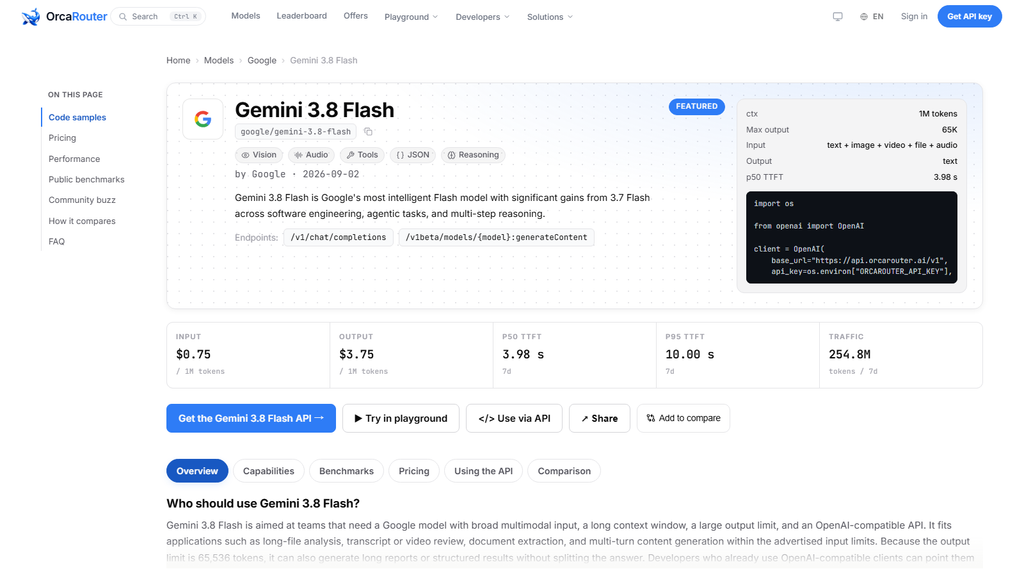
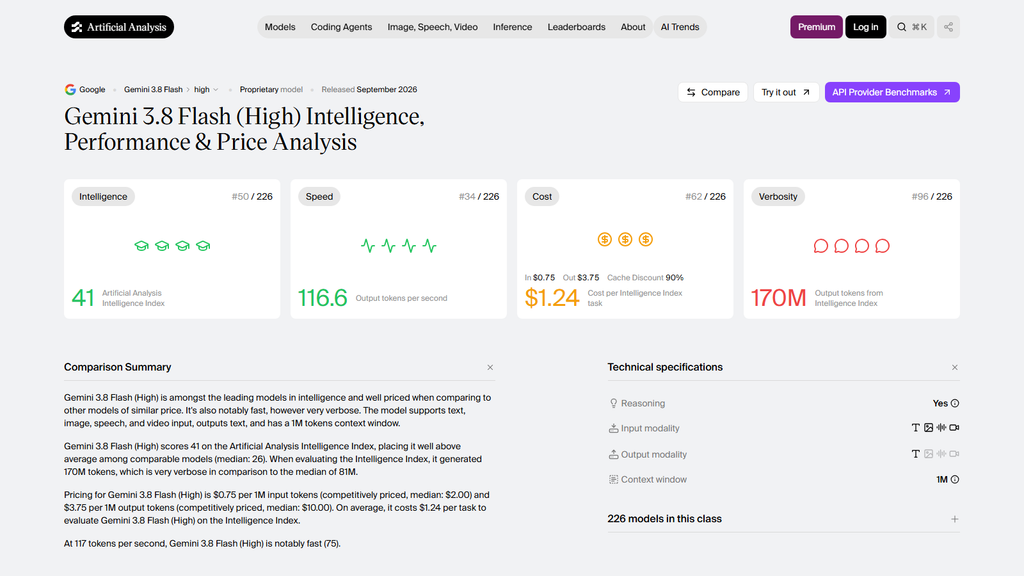
On OrcaRouter we host the Gemini 3.8 Flash model — the latest rung of Google’s Flash line, shipped on September 2, 2026, priced at $0.75 per million input tokens and $3.75 per million output, with a 1M-token context window. Artificial Analysis scores it 41 at the high reasoning setting with a measured output speed of 122.7 tokens per second, and in production its p50 time-to-first-token is 3.87 seconds, with seven-day traffic of 245.5 million tokens — the highest of any Flash model we serve. It is carried at list price on the same key as every other Google model, with the live telemetry on the linked page.
A quarter of a billion tokens in a week is not a niche usage — it is the production default of a generation, and this article is about what makes that particular card the one teams reach for.
Why the newest Flash became the default
The Flash line is Google’s answer to the price-performance middle of the market, and 3.8 Flash arrives at a moment when that middle has gotten competitive. Its $0.75 / $3.75 card sits at the same price as its predecessor — Google held the rate while shipping the new generation, which is the fastest way to move a fleet of production integrations onto the new model. Teams migrating from an older Flash card change nothing about their budget, only their endpoint.
The independent reading backs the migration: 41 (high) on the Intelligence Index is the best score in the current Flash generation, and at 122.7 tokens per second of measured output it is fast enough to be the primary endpoint rather than a fallback. The score, the speed and the unchanged price together make the default-choice case almost automatic.
The timing also matters: 3.8 Flash lands nine weeks after its predecessor and weeks ahead of the generation’s flagship, which makes it the model most teams will touch first in the new line. Google shipped the volume card before the flagship card, the reverse of the usual order, and the traffic number suggests the market responded to exactly that sequence — the cheap, fast, capable card was available first, so it became the default.
The Flash generation, in one table
| model | release | context | input / output | AA index (config) | per-task cost | p50 TTFT |
| Gemini 3.8 Flash | 2026-09-02 | 1M | $0.75 / $3.75 | 41 (high) | $1.24 | 3.87 s |
| Gemini 3.6 Flash | 2026-07-21 | 1M | $0.75 / $3.75 | 34 (high) | $1.60 | 4.10 s |
| Gemini 3.5 Flash | 2026-05-23 | 1M | $1.50 / $9.00 | 33 (high) | $3.69 | 8.21 s |
Release dates and rate cards are what Google lists; the index and per-task costs are Artificial Analysis’s live readings; the TTFT column is production telemetry from the linked page. The table tells a clean upgrade story: the newest rung scores seven points above the previous generation at the same price, and the generation before cost double for a lower score. The one wrinkle is latency — the whole current Flash line carries a first-token time in the four-second range (3.87 s here, 4.10 s on the mid rung), which trails the fastest small cards in the industry by a noticeable margin.
What the traffic number actually means
245.5 million tokens in seven days is the strongest signal in this article because it is not a benchmark and not a claim — it is the endpoint’s own production record on the linked page. Volume like that means teams are not sampling the card; they are running whole pipelines on it, and the number compounds the reasons above: the price is low enough to leave running, the speed is high enough to not throttle, and the score is high enough to trust on real traffic.
The honest caveat that belongs next to the number is the reverse of the usual one: when a card is this cheap and this popular, the risk is not overpaying but under-specifying. A workload that needs the top reasoning tier will find the Flash line’s 41 (high) short of the flagship class — and the traffic number, read carefully, is exactly the evidence to use when someone argues the cheap card can do everything.
Choosing Flash on evidence rather than habit
The decision a team actually faces with a new Flash card is not whether the model is good — the score and the price already answer that — but whether to move production traffic onto it, and that is a question the spec sheet cannot settle. The linked page settles it the only way it can be settled: it shows the new endpoint’s own seven-day window, its real latency distribution at p50, and the volume it is already carrying. For a migration decision, that is more evidence than any announcement.
The 245.5 million weekly tokens are also a small lesson in how the Flash market self-sorts. A card that cheap gets pointed at every workload that does not need the top tier, and the production record on the page is the accumulated judgment of everyone who has already run it. The reason to trust it is that it is the same kind of number your own team would produce — real usage, on the real endpoint, at the real price.
The comparison worth running is against the previous generation, because the migration cost is what most teams actually fear. A workload pinned to 3.5 Flash at $1.50 / $9.00 moves to a card that scores eight points higher for half the price, and the telemetry on the linked page shows a first-token time more than four seconds faster. That is not a marginal upgrade; it is a re-budgeting of the same pipeline. Teams that made the move in the first weeks are already visible in the 245.5 million figure, and the remaining holdouts are mostly waiting on their own evaluation cycles rather than on the model.
The takeaway
Gemini 3.8 Flash is the newest rung of Google’s Flash line: $0.75 / $3.75, a 1M context window, the generation’s best independent score at 41 (high), and 245.5 million tokens of weekly production traffic — the most of any Flash model we serve. It kept the predecessor’s price while raising the score, and its measured p50 first token of 3.87 seconds is honest about the Flash line’s latency profile. If your workload is the middle of the market — high volume, moderate reasoning, price-sensitive — this is the current default, and the linked page shows why.
Run your first month of traffic on the same key you already use for Google models. The endpoint is live at list price, and the telemetry page will tell you within days whether the default deserves your workload.
Sourcing note: release date, context window and rate card are what Google lists and have not been independently reproduced. The Intelligence Index score, output speed and per-task cost are from Artificial Analysis’ live model page, read 2026-10-08, and the 41 was measured at the high reasoning setting. The p50 time-to-first-token and seven-day token volume are OrcaRouter production telemetry from the linked model page. All checked 2026-10-08.
Also Read
- Bring Architectural Concepts Into Accurate Technical Drawings That Support Faster Approvals And Builds
- 25 Other Ways to Say ‘Happy Married Life’(With Examples)
- Best Practices For Handing Off Campaign Management To Another Team