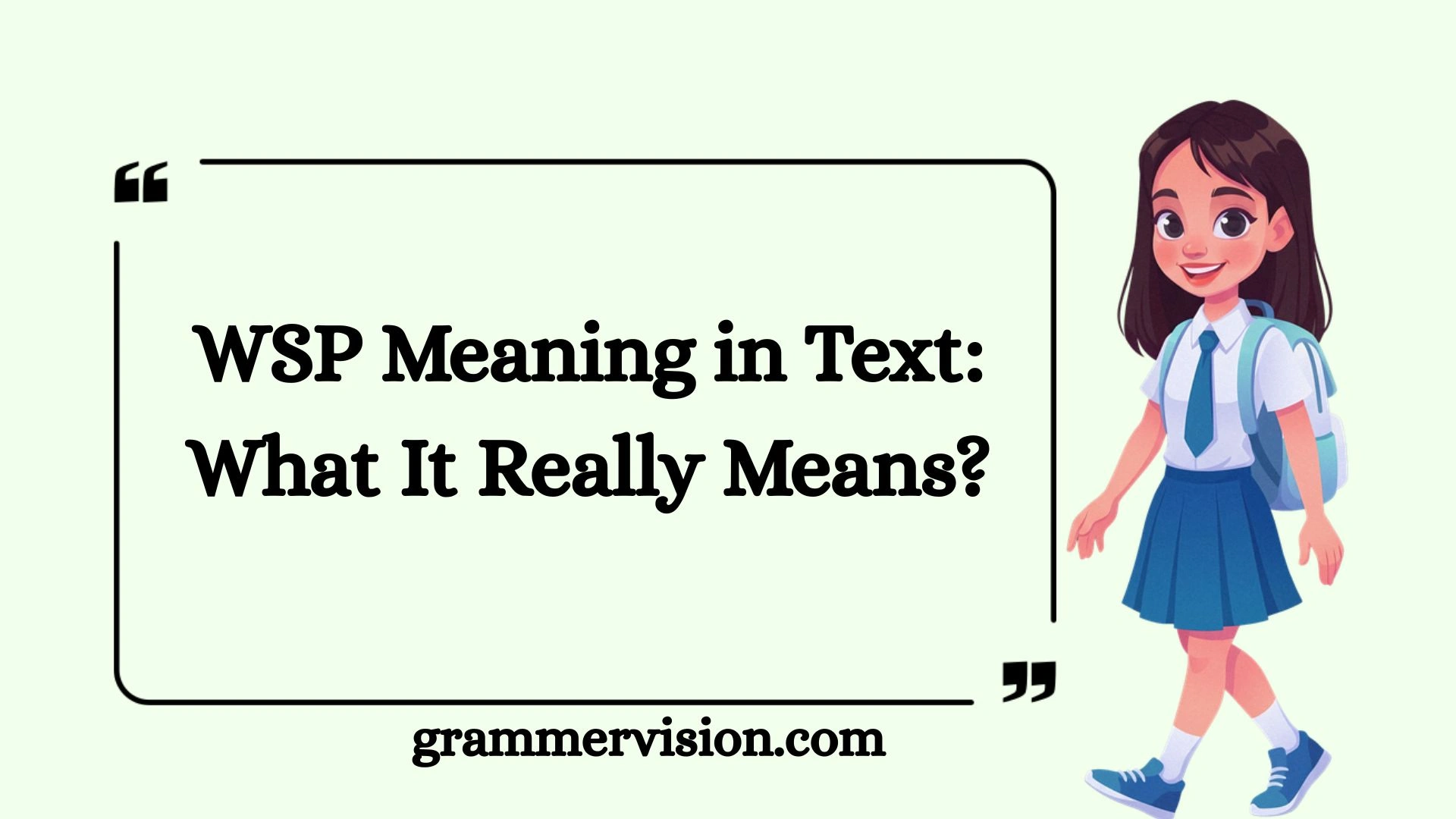
If you’ve seen WSP in a text message, social media chat, or online conversation, you may wonder what this short form means.
The abbreviation WSP is a popular internet slang term used in casual conversations, especially among friends and younger users. It usually means “What’s up?” and is a simple way to start a chat, ask how someone is doing, or check what they are currently doing. Unlike formal greetings, WSP is mostly used in text messages, social media platforms, and online chats because it is quick, friendly, and easy to type. Learning the meaning of WSP and its common uses can help you avoid confusion and reply naturally in different conversations.
In today’s fast-moving digital world, text abbreviations like WSP have become a normal part of online communication. People often use these short phrases to save time while keeping conversations casual and engaging. Although WSP meaning in text is simple, the way you reply can depend on the relationship, situation, and tone of the conversation. Whether you receive it from a friend, classmate, or someone online, knowing how to respond to WSP can make your chats smoother. In this guide, we’ll explain what WSP means, how to use it correctly, the best replies, and when you should avoid using this slang term.
Quick Answer: What Does WSP Mean in Text?
WSP usually means “What’s up?” in texting, online chat, and social media messages. It’s an informal greeting that can mean “How are you?”, “What are you doing?”, or simply “Hey, what’s going on?”
The exact meaning depends on the conversation.
| Text | Likely Meaning |
| WSP? | What’s up? / How are you? |
| WSP bro? | What’s up, bro? |
| Hey, WSP? | Hey, what’s going on? |
| WSP with you? | What are you doing? |
| WSP tonight? | What are you doing tonight? |
| WSP, you good? | What’s going on? Are you okay? |
If someone sends only “WSP?”, they’re usually starting a casual conversation. You can reply with “Not much, you?”, “I’m good! What about you?”, or “Just chilling. What’s up with you?”
What Does WSP Mean in Text?
In text messages, WSP is a shortened version of “What’s up?” It’s part of the informal language people use to communicate quickly online.
Think of it as a digital knock on the door. The person isn’t necessarily asking you to provide a detailed report about your day. More often, they’re simply saying, “Hey, I’m here. Let’s talk.”
The phrase “What’s up?” itself can carry several meanings:
- How are you?
- What are you doing?
- What’s going on?
- Is anything new?
- Do you want to chat?
- Is something wrong? — when the context suggests concern
For example:
Friend: WSP?
You: Not much. Just watching a movie. You?
Here, WSP functions as a casual greeting.
Now consider this:
Friend: WSP with you?
You: I’m heading to the mall.
In this case, the sender probably wants to know what you’re doing.
The surrounding words matter. That’s why you shouldn’t interpret every use of WSP in exactly the same way.
Why Do People Write WSP Instead of What’s Up?
Texting rewards speed. People often shorten familiar phrases because the meaning is already obvious.
Instead of typing:
What’s up?
Someone may type:
WSP?
The shorter version feels quick, relaxed, and conversational. It’s similar to other common texting abbreviations such as BRB, IDK, and WBU.
However, WSP isn’t necessarily a formal acronym. In everyday chat, it’s better understood as texting shorthand.
WSP Meaning in Chat and Text Messages
The WSP meaning in chat generally remains “What’s up?” The real difference comes from the relationship between the people chatting.
A close friend might use WSP as a simple hello. Someone you barely know could use it to break the ice. A person who hasn’t spoken with you for months might send it as an easy way to reconnect.
Here’s how the same message can work in different situations:
| Situation | Message | Possible Meaning |
| Greeting a friend | WSP? | Hey, how are you? |
| Starting a conversation | WSP bro? | Hey, what’s going on? |
| Checking your plans | WSP tonight? | What are you doing tonight? |
| Checking on you | WSP? You okay? | Is something wrong? |
| Making plans | WSP this weekend? | What are your plans? |
| Reconnecting | Hey, WSP? | Hey, how have you been? |
This flexibility explains why WSP appears so often in casual digital communication. It’s short enough to send in seconds while still giving the other person plenty of room to respond.
WSP vs. What’s Up?
There’s no major difference in basic meaning between WSP and “What’s up?”
The biggest difference is tone and format.
- What’s up? — casual and natural in both speech and writing.
- WSP? — more abbreviated and strongly associated with texting or online chat.
- Sup? — extremely casual and often playful.
- Wassup? — a slangy spelling of “What’s up?”
- What’s going on? — slightly more direct and often asks for an actual update.
So, if someone texts WSP, you can mentally expand it to “What’s up?” and then read the surrounding context.
WSP Meaning on Snapchat, Instagram, TikTok, and WhatsApp
The WSP meaning on Snapchat, Instagram, TikTok, and WhatsApp is usually the same: “What’s up?”
There isn’t a special universal meaning that suddenly appears because the message arrives on a particular platform.
Still, the way people use it can vary slightly depending on the setting.
WSP Meaning on Snapchat
On Snapchat, WSP often appears in quick chats between friends, mutuals, or people who have recently added each other.
Snapchat conversations tend to be fast and informal. A person might send:
WSP
You could respond:
Not much. You?
Or:
Just got home. What’s up?
If the person follows WSP with a specific question, pay attention to that second message. It may reveal whether they were simply greeting you or wanted something specific.
For example:
Them: WSP?
You: Nothing much.
Them: You tryna hang out?
The first message was likely a conversation opener. The real purpose appeared in the follow-up.
WSP Meaning on Instagram
On Instagram, WSP commonly appears in DMs. Someone may use it after following you, replying to a story, or simply wanting to start a private conversation.
For example:
Them: WSP
You: Hey! I’m good. What’s up?
If the message arrives after you post a story, context becomes especially important.
Suppose you post a photo from a concert and someone replies:
WSP?
They might simply be asking what you’re doing there. In that case, a natural response could be:
Just at the concert with some friends.
WSP Meaning on TikTok
On TikTok, WSP can appear in direct messages or casual conversations that move from comments into private chat.
It doesn’t generally have a special TikTok-specific definition in ordinary messaging. In most cases, it still means “What’s up?”
A conversation might look like this:
Them: WSP
You: Hey! Not much. You?
Them: Just saw your video lol
Here, WSP is simply an informal way to start talking.
WSP Meaning on WhatsApp
WhatsApp users may use WSP in one-on-one chats and group conversations.
Because WhatsApp is often used for everyday communication, you might see it between friends, classmates, coworkers who know each other casually, or family members.
For example:
Friend: WSP?
You: Just finishing dinner.
Friend: Wanna call later?
Again, the abbreviation is simply opening the conversation.
Is WSP the Same as “What’s Up?”
Yes. In most texting situations, WSP means “What’s up?”
The letters aren’t usually meant to represent a completely different phrase. They’re simply a compressed version of a familiar expression.
You may see several forms:
- WSP
- wsp
- Wsp
- WSP?
- wsp?
In casual digital communication, these generally carry the same meaning.
Capitalization doesn’t usually matter. The punctuation can influence the tone slightly, though.
Compare:
WSP?
with:
WSP
The first can feel more like a direct question. The second may feel even more casual or abrupt.
Now compare:
Heyyy, wsp?
That version feels warmer and more playful because of the added greeting and stretched spelling.
The abbreviation itself hasn’t changed. The presentation has.
How to Reply to WSP
The best response to WSP depends on what you want from the conversation.
If you want to keep things short, answer briefly. If you’d like to chat, give the person something they can respond to.
The golden rule is simple:
If you want the conversation to continue, don’t make your reply impossible to answer.
For example, replying “Nothing” can accidentally shut down the conversation. Saying “Not much, just watching a movie. What are you up to?” gives the other person a clear path forward.
Casual Replies to WSP
These responses work well with friends and casual acquaintances:
- Not much, you?
- Nothing much. What’s up with you?
- Just chilling. You?
- I’m good. How about you?
- Not much happening here.
- Just relaxing at home.
- All good. What’s going on?
The safest all-purpose response is:
Not much, you?
It’s short, friendly, and keeps the conversation moving.
Friendly Replies to WSP
If you want to sound warmer, add a little context.
- Hey! I’m doing pretty good. How about you?
- Not much! What have you been up to?
- Just relaxing. How’s your day going?
- I’m good! Anything interesting happening with you?
- Just got home. What are you up to?
These responses work particularly well when you haven’t talked to the person recently.
Short Replies to WSP
Sometimes you don’t have the energy for a long conversation. That’s perfectly fine.
You can say:
- Nm, u?
- All good.
- Chilling.
- Nothing much.
- I’m good.
- Just here lol.
- Same old, same old.
These replies are informal and work best in casual conversations.
Replies When You’re Busy
If you’re occupied, you don’t have to disappear or write a long explanation.
Try:
- I’m a little busy right now. What’s up?
- Just finishing something. Everything okay?
- I’m working at the moment. Can I text you later?
- Pretty busy right now, but I’m good!
- Can’t talk much right now. What’s going on?
These messages acknowledge the person without pretending you have time for a full conversation.
How to Reply to WSP From a Crush
When your crush texts WSP, the safest strategy is to avoid giving a dead-end answer.
You don’t need to launch into a Shakespearean monologue. Just give them a little something to work with.
For example:
Them: WSP?
You: Not much! Just relaxing. What are you up to?
That’s friendly and open.
If you’re comfortable being slightly flirty, you can turn up the warmth:
- Not much. I was wondering when you’d text me.
- Better now that I’m hearing from you.
- Nothing exciting yet. What are you doing?
- Just chilling. Were you thinking about me?
- Not much. What’s your plan for tonight?
However, don’t force the flirtiness. If your relationship is still new, a playful but natural response usually works better than an overly intense one.
Case Study: Turning WSP Into a Real Conversation
Consider this exchange:
Them: WSP?
You: Nothing.
Them: Oh okay.
The conversation dies quickly.
Now compare it with:
Them: WSP?
You: Not much! Just watching a movie. What are you up to?
Them: I’m bored at home lol.
You: Same. What movie are you watching?
The second response creates conversation hooks. Each message gives the other person something to pick up.
That’s the trick. Don’t just answer the question. Give the conversation somewhere to go.
How to Reply to WSP From a Friend
With friends, you can be more relaxed. Your answer can also hint at what you’d like to do next.
Try:
- Nothing much. You wanna hang out?
- Just gaming. You?
- I’m bored. What’s the plan?
- Just chilling at home.
- Not much. Wanna grab something to eat?
- Same old stuff 😂 What’s up with you?
- I’m free tonight. You doing anything?
A friend might use WSP because they want to make plans. You won’t always know that from the first message, so pay attention to what comes next.
For example:
Friend: WSP?
You: Just chilling.
Friend: You wanna come over?
Here, the initial greeting was really the first step toward an invitation.
How to Reply When You Don’t Want to Talk
Not every WSP deserves a full conversation.
Maybe you’re tired. Perhaps you’re working. Or you simply don’t feel like chatting. You can respond politely without opening the floodgates.
Consider:
- I’m good, just a little busy.
- All good here!
- Not much. Hope you’re doing well.
- I’m okay, just having a quiet day.
- A little busy right now. I’ll catch up with you later.
If someone repeatedly messages you when you don’t want to engage, you can be more direct:
Hey, I’m not really up for chatting right now. I’ll talk to you later.
That’s clear without being unnecessarily harsh.
Your response should match the relationship. You don’t owe every casual message a detailed explanation.
WSP vs. Other Common Texting Abbreviations
Texting shorthand can look like alphabet soup when you’re unfamiliar with it. Fortunately, many abbreviations follow simple patterns.
| Abbreviation | Meaning | Typical Use |
| WSP | What’s up? | Casual greeting or conversation starter |
| SUP | What’s up? | Very casual greeting |
| WBU | What about you? | Asking the other person the same question |
| HBU | How about you? | Returning a question |
| NM | Not much | Common response to WSP |
| IDK | I don’t know | Showing uncertainty |
| BRB | Be right back | Temporarily leaving a chat |
| LOL | Laughing out loud | Showing amusement |
Some of these naturally fit together.
For example:
Them: WSP?
You: NM, WBU?
Translated into standard English:
Them: What’s up?
You: Not much. What about you?
Another example:
Them: WSP?
You: Just chilling. HBU?
That means:
Them: What’s up?
You: Just relaxing. How about you?
WSP vs. SUP
Both WSP and SUP can mean “What’s up?”
The difference is mostly stylistic.
WSP looks like an abbreviation created from the phrase itself. SUP is based on the shortened pronunciation of “what’s up?”
Both are highly informal.
WSP vs. WBU
These aren’t interchangeable.
WSP asks:
What’s up?
WBU asks:
What about you?
You might use them together:
WSP?
Not much. WBU?
That’s a perfectly natural texting exchange.
Examples of WSP in Real Text Conversations
Seeing the abbreviation in context makes its meaning much easier to understand.
Example: WSP Between Friends
Alex: WSP?
Sam: Not much. Just watching TV.
Alex: Wanna play later?
Sam: Yeah, I’m down.
Here, WSP starts a casual conversation that eventually leads to making plans.
Example: WSP From Someone You Haven’t Talked to Recently
Jordan: Hey, WSP?
Taylor: Hey! I’m good. It’s been a while. How have you been?
The sender may simply be reconnecting.
A good response acknowledges the gap rather than replying with a flat “Nothing.”
Example: WSP From a Crush
Them: WSP?
You: Not much! Just relaxing. You?
Them: Same. I’m bored.
You: Sounds like we need better plans 😂
This keeps the tone playful without trying too hard.
Example: WSP When Someone Wants to Make Plans
Friend: WSP tonight?
You: Nothing planned. Why?
Friend: Wanna grab dinner?
Here, WSP tonight? doesn’t simply mean “How are you?” The addition of “tonight” makes it more likely that the person is asking about your availability.
Example: WSP From Someone You Don’t Know Well
Them: WSP?
You: Hey! I’m good. What’s up?
This is a polite response that doesn’t reveal unnecessary personal information.
Does WSP Have Other Meanings?
Although “What’s up?” is the most common interpretation in casual texting, WSP can have other meanings in specialized contexts.
The abbreviation appears in different fields and organizations. For example, depending on the industry, WSP may refer to a company, organization, technical term, or project name.
That doesn’t mean you should assume an alternative meaning whenever you see the letters.
Context is king.
If someone sends:
WSP?
in an Instagram DM, “What’s up?” is overwhelmingly the natural interpretation.
If you’re reading WSP in a technical document, business report, or professional discussion, the surrounding subject matter may point to another definition.
The practical rule is straightforward:
In casual texting, read WSP as “What’s up?” unless the context clearly indicates otherwise.
This approach prevents unnecessary confusion.
Is WSP Formal or Informal?
WSP is informal texting slang.
It’s appropriate when you’re communicating casually with people who understand shorthand and relaxed language.
WSP is generally suitable for:
- Friends
- Close classmates
- Casual group chats
- Informal DMs
- Social media conversations
- People you regularly text
WSP usually isn’t suitable for:
- Formal business emails
- Job applications
- Cover letters
- Academic assignments
- Official requests
- Professional correspondence with unfamiliar people
For example, don’t open a job application email with:
WSP, I wanted to ask about the position.
That sounds far too casual.
Instead, use:
Hello, I’m writing to ask about the status of my application.
In professional settings, phrases like “How are you?”, “How’s it going?”, or a direct opening are more appropriate.
Is WSP Rude?
No, WSP isn’t inherently rude. It’s generally a neutral and casual greeting.
However, a message can feel abrupt depending on the situation.
Compare:
Hey! WSP?
with:
WSP.
The first feels warmer because of “Hey!” and the question mark. The second may feel more clipped.
That doesn’t automatically mean the sender is annoyed. Some people simply text in a very brief style.
Context matters more than punctuation.
If your best friend always sends one-word messages, “WSP” probably doesn’t carry any hidden attitude. If someone normally writes complete sentences and suddenly sends “WSP.”, you might reasonably wonder whether something has changed.
Still, don’t read too much into three letters. Text messages lack the facial expressions, voice tone, and body language that make spoken communication easier to interpret.
Why Do People Use WSP Instead of “What’s Up?”
The answer is simple: convenience.
Typing WSP takes less effort than typing “What’s up?” It’s also instantly recognizable to many people who regularly use texting shorthand.
There are several reasons people choose it:
- It’s quick.
- It feels casual.
- It fits informal texting culture.
- It works well as a conversation starter.
- It doesn’t require a long answer.
Digital communication has always encouraged abbreviation. People use shorthand because online conversations move quickly.
Still, there’s a subtle difference between being brief and being cold.
Compare:
WSP
with:
Heyyy! What’s up?
Both communicate essentially the same idea. The second message simply carries more warmth.
That’s why context, punctuation, emojis, and extra words can shape the emotional tone around an abbreviation.
Common Mistakes When Interpreting WSP
A few simple mistakes can make a straightforward message seem more complicated than it really is.
Assuming WSP Always Has a Specialized Meaning
In ordinary texting, WSP usually means “What’s up?”
Don’t jump to a technical definition unless the context supports it.
Treating WSP as Formal Language
WSP belongs to casual digital communication. It doesn’t belong in every type of writing.
Giving a Dead-End Response
If someone wants to chat, replying “Nothing” may accidentally end the conversation.
Try:
Not much. You?
That tiny addition can make a big difference.
Overthinking the Message
Sometimes WSP really does mean nothing more than “Hey, how are you?”
You don’t need to decode every casual text like it’s a secret message from a spy movie.
Ignoring Context
A message like “WSP tonight?” probably asks about your plans.
A message like “WSP? You okay?” may express concern.
The abbreviation remains the same. The surrounding words change the meaning.
What Does WSP Mean From a Girl?
When a girl texts WSP, it usually means exactly what it means from anyone else: “What’s up?”
The message alone doesn’t prove romantic interest.
She could be:
- Greeting you
- Starting a conversation
- Asking what you’re doing
- Checking whether you’re available
- Reconnecting after some time
- Looking for a reason to talk
Context matters.
If she follows it with questions, keeps replying quickly, or actively carries the conversation, that may show she’s interested in talking. However, WSP by itself isn’t enough to establish romantic interest.
A natural reply might be:
Not much! Just relaxing. What are you up to?
Let the conversation develop naturally rather than trying to read too much into the opening message.
What Does WSP Mean From a Guy?
When a guy texts WSP, it generally means “What’s up?” just as it would from anyone else.
He might be checking in, starting a conversation, or asking what you’re doing.
For example:
Him: WSP?
You: Not much. What’s up?
Him: You free later?
In this case, the conversation reveals his intention. The first message simply opened the door.
Again, don’t assume romantic interest based on WSP alone. Look at the broader pattern of communication.
What Should I Say After Someone Texts WSP?
If you’re unsure what to say, use this simple formula:
Answer + question back
For example:
I’m good, just relaxing. You?
Or:
Not much! I just got home. What are you up to?
Or:
I’m free tonight. What’s going on?
This approach works because it does two jobs at once. You answer the greeting while giving the other person a reason to respond.
Here are some ready-to-use options:
| Your Situation | Good Reply |
| You want to keep it casual | Not much, you? |
| You’re doing well | I’m good! How about you? |
| You’re busy | I’m busy right now. What’s up? |
| You’re bored | Nothing much. I’m bored lol. |
| You want to hang out | Not much. Wanna do something? |
| You like the person | Not much! What are you up to? |
| You don’t want to talk | I’m good, just a little busy. |
| You haven’t talked recently | Hey! I’m good. How have you been? |
What Is the Best Response to WSP?
For most situations, the best response is:
Not much, you?
It’s short. It’s friendly. Most importantly, it keeps the conversation open.
If you want to add more personality, try:
Not much! Just chilling at home. What are you up to?
If you’re talking to a close friend:
Nothing much. What’s the plan?
If you’re talking to someone you like:
Not much. I was just wondering when you’d text me 😉
Your response doesn’t need to be clever. It just needs to match the situation.
FAQs
What does WSP mean in text messages?
WSP stands for “What’s Up?” It is a casual greeting used in text messages, social media, and online chats to ask someone how they are doing or what they are doing.
Is WSP the same as “What’s Up?”
Yes. WSP is simply a shortened version of “What’s Up?” People use it to save time while texting on platforms like Snapchat, Instagram, TikTok, and WhatsApp.
How should I reply to WSP?
You can keep your reply casual. Some common responses include:
- “Not much, you?”
- “Just relaxing.”
- “Working right now.”
- “Hey! What’s up with you?”
Your response depends on the conversation and your relationship with the sender.
Can WSP be used in professional conversations?
Generally, WSP is best for informal conversations with friends, family, or people you know well. In professional emails or workplace chats, it’s better to use greetings like “Hello”, “Hi”, or “How are you?”
Where is WSP commonly used?
You’ll often see WSP on Snapchat, Instagram, TikTok, Facebook Messenger, WhatsApp, and regular SMS text messages. It has become a popular part of modern texting slang and online communication.
Conclusion
Understanding the WSP meaning in text makes it easier to communicate in today’s fast-moving digital world. Whether someone sends WSP in a text message, on Snapchat, Instagram, or another social media platform, they’re usually just saying “What’s Up?” and starting a friendly conversation. Knowing its meaning helps you respond naturally and confidently.
Overall, WSP is one of the most common text abbreviations used in casual chats. It’s quick, simple, and friendly, making it perfect for everyday messaging. Now that you know what WSP means, when to use it, and how to reply, you’ll have no trouble understanding or using this popular piece of texting slang in your own conversations.